Optimize Operations with Integrated Dispatch & Tracking
VIACHAIN’s FleetManager and McLeod’s LoadMaster work together to help Mike Tamana Trucking make gains in efficiency.


The challenge
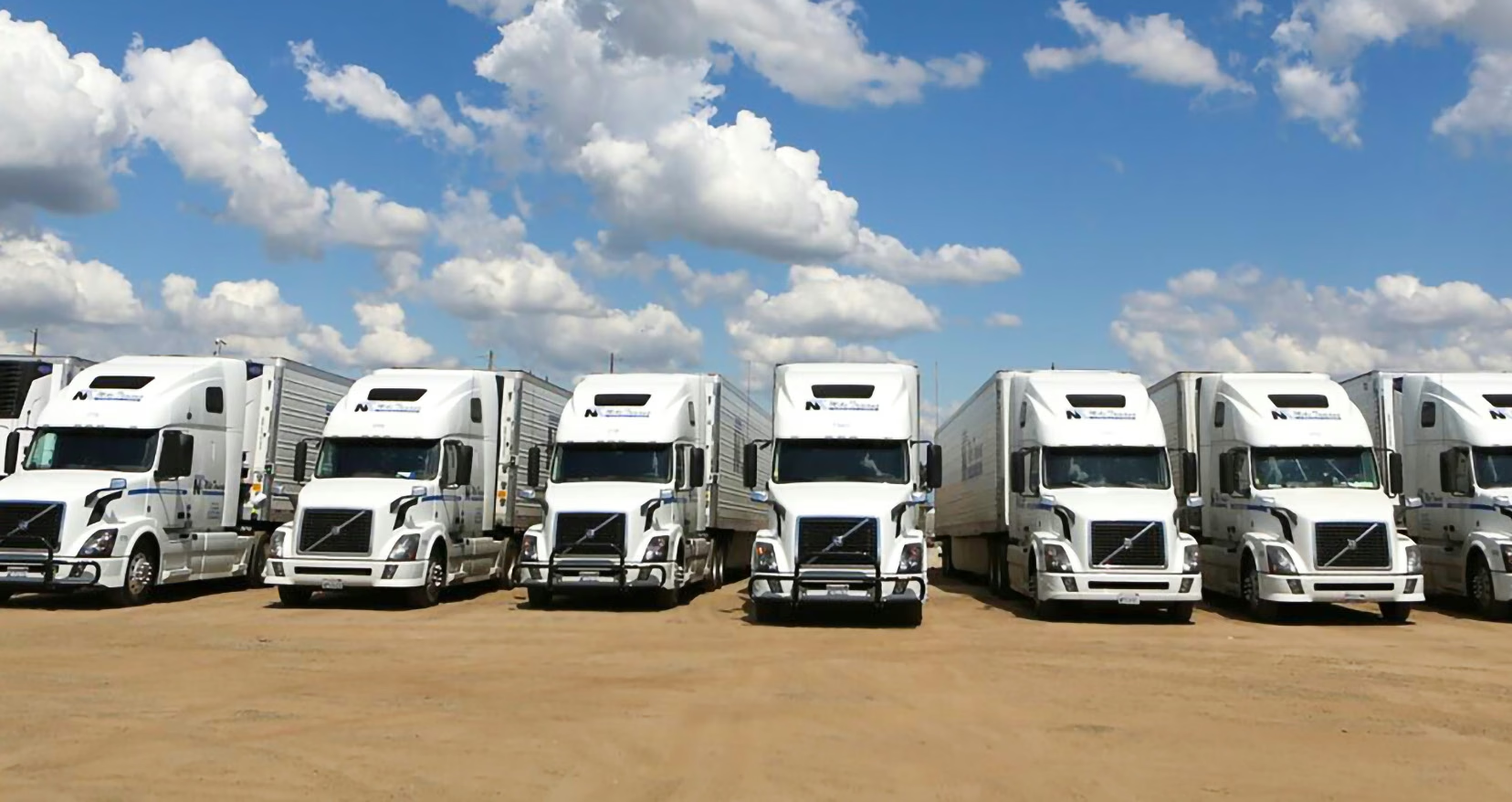
Mike Tamana Trucking operates out of Ceres, California, and specializes in the transportation of temperature-controlled freight across the western states and Texas. Here are some of the company’s most prominent business challenges:
Ensuring reefer temperatures for food freight are monitored and maintained: According to owner Aman Tamana, one of the fundamental business challenges is avoiding the worst-case scenario where a reefer’s temperature gets out of the acceptable range. “If a temperature-monitoring unit fails, we’re vulnerable. If that unit is on a reefer that happens to have a temperature problem, we’re in trouble,” Tamana says. “That’s why we needed to have technology that’s dependable and suppliers who respond to our issues.”
Operating efficiently in spite of rapid growth: The carrier has experienced rapid growth, and this brings its own set of challenges. The company needs to operate more efficiently while maintaining high standards of customer service.
Reducing operating costs by improving fuel economy: Management is focused on improving fuel economy in an effort to reduce operating costs. “We’ve grown so much that we have to implement changes in stages,” Tamana says. “We’re planning on focusing on fuel economy next. We’re going to train the drivers and put bonus programs in place.”
Putting the right drivers on the right loads: The move to electronic logging devices (ELDs) is increasing the pressure on carriers to ensure that they pick the right driver for each load. Service failures can happen easily if a driver runs out of driving time before the load is delivered.
The solution
“We’re in the perishable food business, so it’s highly critical that our reefers maintain the right temperatures,” Tamana says. “We use VIACHAIN’s temperature-monitoring units heavily on every load. We double-check, and we’re able to do that easily because the data feeds directly into LoadMaster. Temperature and location data come every five minutes.”
People throughout the company use the system, including driver managers, the maintenance crew, and the safety department. All users can customize the interface to suit their needs. “You can set it up to show the data that’s relevant to what you’re doing in your part of the company,” Tamana says.
When the order is entered in LoadMaster, the set point for the trailer temperature can be specified along with the acceptable variation up or down from this set point. If the reefer’s temperature veers out of that range, an alert appears instantly through LoadMaster.
The VIACHAIN telematics system can also track driver behavior, such as the use of cruise control, harsh acceleration, and idle time. VIACHAIN also tracks the time between the driver’s use of the accelerator and the brake pedal. This tells us how much time the driver is coasting. The most skilled drivers learn to anticipate when they’ll need to slow down or stop and avoid going full speed until the last second. This helps with fuel mileage, plus it shows that the driver is attentive to driving and is noticing what’s going on around the truck.
“We’re definitely watching driver behavior,” Tamana says. “Our fleet averages at 5.4 mpg right now. We’re going to start working with the drivers, and if we bump it up to 6.5 by using all of the data that’s available from VIACHAIN, we’ll save over $50,000 on fuel each month.”
Mike Tamana Trucking also implemented the VIACHAIN ELD, and now the hours-of-service (HOS) data feeds into LoadMaster. When loads are assigned, dispatchers have the HOS data in front of them. “When we preplan a truck, we click on Driver Feasibility in LoadMaster,” Tamana says. “It pulls in all of the HOS and location data and tells you if the plan is achievable with the driver you’ve chosen.”
The benefits
Tamana describes a host of benefits that VIACHAIN and McLeod are bringing to his company:
Reliable technology and great customer support: “We used other companies and had problems with faulty technology. Some of the units weren’t working, so we weren’t getting any location data. We’re not a large carrier, and it seems that some technology companies focus all of their energy on the large carriers, so the customer support was not good. When we switched to VIACHAIN, the level of support was just awesome. I don’t think we had a unit that was not pinging the locations. When there was an issue, it was fixed right away.”
The integrated automation boosts efficiency: “We automatically know when a truck arrives at or leaves a customer site with geofencing. The system automatically updates in McLeod. No driver interaction is needed.”
Location data helps in multiple ways: “The position updates show where the vehicle actually is, so LoadMaster can determine which truck is in the best position to take the next load. If a truck is broken down, having the location data helps dispatchers find the nearest available truck. It also helps maintenance get a repair crew there quickly.”
Fueling is handled more efficiently, and we can prevent fuel theft: “VIACHAIN monitors tractor and reefer fuel levels. When we drop trailers at customer sites, we may need to be certain that the reefer engine has fuel. We set up alerts that let us know if the fuel level is too low when the trailer goes into the geofence. That way, we can ensure the driver puts fuel in the reefer before dropping it. Previously, we would have occasions when a driver would drop a reefer that was low on fuel, and this caused headaches. The customer may start loading the trailer and notice that it’s running low on fuel. In that case, we had to scramble to send someone to fill it up or send a driver early to pick it up. With VIACHAIN, we avoid that. We can also track fuel levels in the tractor or reefer against data on fuel purchases and get a deviation report. So if a driver bought fuel at a specific time, but the tank level didn’t go up, it would mean fuel theft.”
We know when a driver is running behind: “One of the big benefits of the location data is that we get notifications if the driver is running behind and is not expected to make the required ETA.”
This data is immediately available within LoadMaster, so we see it easily and can plan ahead.”
HOS data enables preplanning with McLeod Feasibility: “Hours of service data flows into McLeod from VIACHAIN and helps us avoid the problem of putting a driver on a load without enough hours to deliver on time. The Feasibility feature in LoadMaster is excellent for helping us determine which drivers can handle the loads. Our preplanning is smoother, and the drivers are happier. The integration means that our dispatchers don’t have to switch back and forth between portals to manage the HOS data and the load assignments. Everything is right there.”
Preventive maintenance is better: “VIACHAIN automatically brings in odometer readings, which helps with preventive maintenance scheduling. We can plan service appointments based on utilization, not time intervals.”
Keeping tabs on the locations of trailers not in use is much easier: “We never have lost a trailer, but in the past, we’ve spent a lot of time manually backtracking to see where we last took a trailer. Now we have geofences, so we can quickly see that we have six trailers parked at this location and four trailers parked at that location. It’s much easier to find trailers.”
Improved customer relations: “Driver managers can manage by exception and see a board that has only late loads. With VIACHAIN location data flowing into LoadMaster, we know when a load is running late. It gets marked in red on the dispatch screen. We can then tell our customer ahead of time, ‘We’re running two hours behind,’ and we can generally do this about 24 hours ahead. We don’t wait until the last minute, and customers really appreciate that. At the end of the day, our customers understand that it’s trucking and delays can be unavoidable at times. It’s the communication about being late that makes the difference.”
We’ve seen a reduction in claims: “Before we had VIACHAIN, we always had about four or five claims each year as a result of the reefer temperature getting out of the acceptable range. Drivers said it was not their fault, and we couldn’t catch it in time. With the system, we can now react to a temperature issue as it happens.”
Drivers like the VIACHAIN ELD: “The VIACHAIN ELD does the job. It’s user-friendly, and we’ve had no complaints from the drivers. After they try it, they like it.”
The technology is very easy to use: “The systems from both VIACHAIN and McLeod are very intuitive and easy to use. With VIACHAIN, we started by testing the system on three trucks and three trailers. I just kind of fell in love with the way it works. It took us only a few minutes to learn how to navigate.”
We have true business partners: “Working with the people at VIACHAIN has been great! I have a lot of great ideas, and I love technology, and I was allowed to talk to the engineers, and they were willing to listen, so the people really made the difference for us. It felt like we were working with a family.”
VIACHAIN and McLeod integrationmakes life easier
Every carrier wants to improve load-planning efficiency, increase fuel economy, and improve customer relations. When you’re carrying temperature-sensitive loads, you also have to worry about maintaining the right temperature to avoid spoiled freight. FleetManager from VIACHAIN provides visibility into tractor and trailer location, reefer temperatures, fuel levels, and driver behavior through a single platform. LoadMaster from McLeod uses the VIACHAIN data to facilitate load planning, manage drivers’ HOS, provide alerts for reefer temperature fluctuations, and more. The FleetManager integration with LoadMaster means that data can be accessed easily, so actions can be taken to improve the business. In all of these ways, VIACHAIN and McLeod are working together to make life easier for everyone across your organization.
More customer stories
.avif)
.avif)
.avif)